

A fleet manager I spoke with last year had no idea one of his drivers was braking hard 30 to 40 times per shift until the GPS data showed up on his dashboard. No complaints had come in. No accidents yet. But the wear on that vehicle’s brake pads told a different story, and the next repair bill would have told a worse one.
Most commercial fleet owners assume their drivers perform well on the road because nothing has gone wrong recently. Silence does not mean safety. Without real visibility into actual driving behavior, small risk patterns build quietly until they turn into insurance claims, injured drivers, or compliance violations that nobody saw coming.
GPS tracking for driver safety turns invisible behavior into measurable data. Every speeding event, hard brake, aggressive acceleration, and long idle period gets logged, timestamped, and sent to your dashboard in real time.
This guide covers exactly how fleet managers use that data to reduce accidents, lower insurance costs, and build safer driving habits across their entire commercial fleet.
What Does GPS Tracking for Driver Safety Actually Monitor?
GPS tracking systems built for commercial fleets do far more than show vehicle locations on a map. The behavioral data layer is where driver safety gets managed, and most fleet managers are surprised by how much detail modern platforms actually capture.
A solid fleet tracking system monitors all of the following in real time:
- Speeding and aggressive acceleration: Every time a driver exceeds the speed threshold you set, the system logs it with a timestamp, GPS location, and vehicle ID. Repeated speeding on specific routes or shifts points directly to the drivers and habits that need attention first.
- Harsh braking and sudden stops: Late, hard braking is one of the most reliable indicators of distracted or aggressive driving. The system flags every event, allowing fleet managers to see whether a driver consistently follows too closely or regularly reacts to situations that better positioning could have avoided entirely.
- Excessive idle time: Long idle periods waste fuel, but from a safety angle they can also flag a driver who is lost, off-route, or spending time at an unscheduled location, all of which are worth investigating.
- After-hours vehicle movement: Unauthorized use outside operating hours is both a liability and security concern. GPS systems log movement from ignition on to ignition off regardless of the clock.
Once fleet managers see how much behavioral data accumulates in a single week across even a small fleet, the question shifts from “do we need this?” to “how did we manage without it?”
How Does Driver Behavior Data Reduce Fleet Accidents?
Driver behavior data reduces accidents because fleet managers can step in before a pattern becomes an incident.
Without tracking in place, a driver with a speeding habit keeps that habit until something goes wrong. With GPS data running, a fleet manager sees the pattern within the first week of monitoring and schedules a coaching conversation before that driver causes an accident or puts someone at risk on the road.
Research from the Federal Motor Carrier Safety Administration (FMCSA) consistently finds that human error contributes to more than 90 percent of commercial vehicle crashes. Behavioral data addresses the root cause directly rather than waiting to respond after damage has been done.
The downstream benefits build up quickly too. Fewer accidents mean lower vehicle repair bills, fewer days with vehicles pulled out of service, and significantly less time spent managing insurance claims and legal exposure. A single preventable accident in a commercial fleet can cost anywhere from $16,000 to well over $70,000 when factoring in vehicle damage, medical costs, legal fees, and lost operational time, according to the National Safety Council.
Does GPS Tracking Help Lower Fleet Insurance Premiums?
Yes, and for many fleets the premium reduction alone covers the cost of the tracking platform within the first policy year.
Commercial fleet insurance is risk-priced. GPS driver behavior data is one of the clearest ways to show an insurer that a fleet’s risk profile has dropped. When a fleet manager brings telematics reports to a renewal meeting that document reduced speeding events, lower harsh braking frequency, and zero after-hours incidents across the past policy year, the conversation with a carrier changes entirely.
Most commercial fleet insurers currently offer premium discounts ranging from 5 to 20 percent for fleets using active GPS monitoring with documented driver behavior improvement. On a fleet policy running $50,000 per year, even a 10 percent reduction saves $5,000 annually, from a single renewal conversation backed by clean data.
Some carriers have started requiring telematics as a condition of coverage for high-mileage or heavy commercial operations, so having GPS tracking active also eliminates the risk of a carrier declining to renew altogether.
How Do Fleet Managers Coach Drivers Using GPS Data?
The data only produces safety improvements when someone actually acts on it. The most effective fleet managers build a simple weekly or monthly review process around GPS behavior reports.
Framing the data as coaching rather than discipline makes a significant difference in how drivers respond. Showing a driver their own speeding frequency chart and comparing it to the fleet average tends to land far more effectively than a one-sided conversation built on a complaint with no supporting evidence.
A practical coaching cycle using GPS data looks like this:
- Pull a weekly driver behavior report covering speeding events, harsh braking count, and idle time per driver
- Identify the two or three drivers with the highest incident counts for that period
- Share each driver’s own data in a private conversation, walk through the specific incidents flagged, and agree on a measurable target for the next reporting period
- Run the comparison again the following week and acknowledge visible improvement publicly when it shows up
Fleets that run this process consistently report meaningful drops in speeding and braking events within 30 to 60 days, because visibility alone starts changing how drivers behave on the road.
What Role Do Dash Cams Play in Fleet Driver Safety?
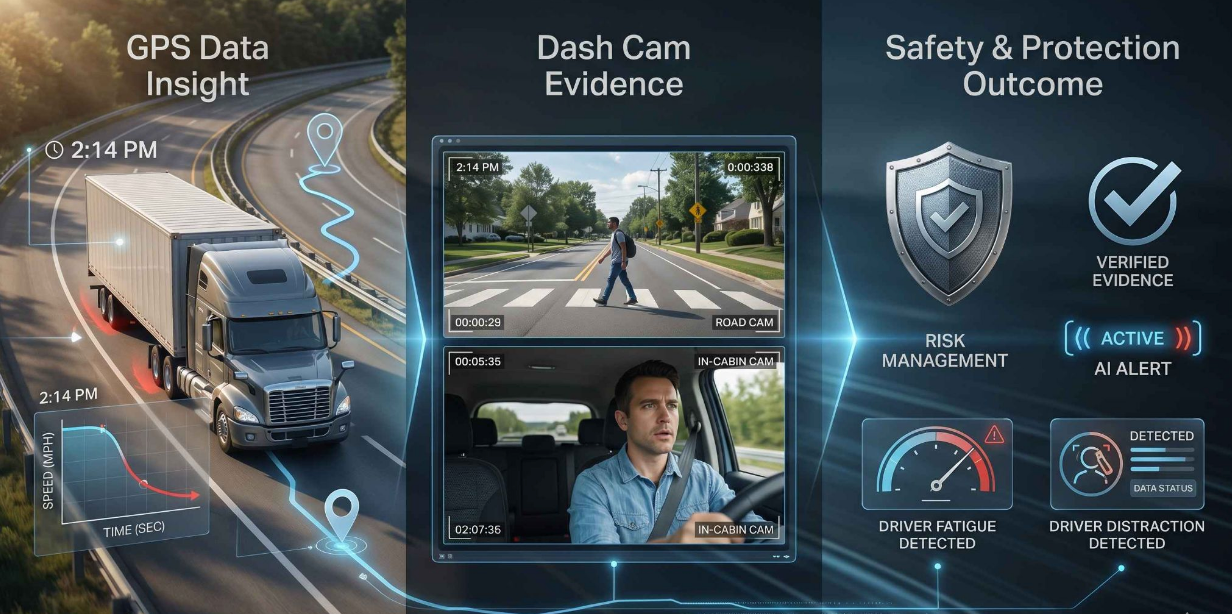 Dash cams work alongside GPS tracking to give fleet managers both behavioral data and visual evidence tied to the same event.
GPS data tells you a harsh braking event happened at 2:14 pm on a specific route. A paired dash cam shows what triggered it: whether the driver was following too closely, a pedestrian stepped out unexpectedly, or road debris required a sudden stop. That context completely changes how a manager responds and whether the driver needs coaching or reassurance.
For insurance and legal protection, the video record often decides whether a claim gets resolved quickly or stretches into a dispute. Fleets that combine GPS tracking with AI-powered dash cams have documented reductions in false claims, because timestamped footage provides clear evidence that either supports or contradicts an account before legal costs accumulate.
BrickHouse GPS offers AI-equipped dual-lens dash cams that capture road-facing and in-cabin footage simultaneously. The in-cabin recording is especially useful for long-haul commercial drivers because the system detects early fatigue signals like head position changes and sends a real-time alert to the driver before the situation reaches a dangerous point.
How Long Before GPS Tracking Improves Driver Safety?
Most fleet managers see measurable behavioral improvements within the first 30 to 60 days of deploying GPS tracking, provided the data gets reviewed and acted on consistently.
The initial improvement happens fast because drivers adjust behavior when they know monitoring is active. Speeding events drop, idle time shortens, and harsh braking frequency falls almost immediately after a fleet goes live. The deeper, sustained improvements come from the coaching cycle: reviewing data, identifying patterns, and following up with individual drivers over weeks and months.
Insurance benefits show up at the next renewal cycle once you have six months or more of behavioral data to bring to your carrier. Maintenance cost reductions appear gradually as driving habits improve and vehicles experience less mechanical stress from aggressive operation.
A five-vehicle commercial fleet that commits to active data review can expect noticeable safety improvements within one quarter and measurable financial returns within two.
What to Look for in a GPS Tracking System for Driver Safety
Not every GPS platform gives fleet managers the behavioral tools needed to produce real safety improvements. Several capabilities make the difference between a tracking system that shows locations and one that actually changes driving behavior.
The features that drive real safety improvements are:
- Real-time driver behavior alerts for speeding, harsh braking, and aggressive acceleration, not just end-of-day summaries delivered too late to act on
- Per-driver reporting that makes individual performance visible and directly comparable across the fleet
- Geofencing with alert capability for after-hours movement and unauthorized use
- Integration with dash cam footage so behavioral events link to the actual video clips from that moment
- Maintenance scheduling tied to engine hours and mileage, so mechanical issues get flagged before they create safety risks on the road
BrickHouse GPS covers all of these within a single platform, with hardware options that include hardwired units for permanent fleet vehicles, OBD plug-in devices for fast rollout, and battery-powered trackers for trailers and assets. Devices ship within 48 hours, and the service runs month-to-month with no long-term contract required.
Conclusion: The Road Gets Safer When the Data Stays On
Every mile a commercial fleet runs without behavior monitoring is a mile where a safety risk could be growing without anyone noticing.
Fleet managers who improve their safety records year over year are not necessarily the ones with the most experienced drivers. They are the ones who use GPS data consistently, review it regularly, and treat every behavior flag as a coaching opportunity rather than a disciplinary event.
Safety records improve with visibility. The tools are available, the data is reliable, and the cost of running a GPS tracking system is almost always lower than the cost of one preventable accident that nobody saw coming until it was too late.
FAQ
Why is driver safety important in commercial fleet management?
A single commercial vehicle accident can result in six-figure repair costs, insurance claims, lost vehicle availability, regulatory scrutiny, and potential litigation. Active safety monitoring prevents these outcomes by identifying and addressing risky driving patterns before they lead to an incident rather than after.
What driving behaviors does GPS fleet tracking monitor?
GPS fleet tracking systems monitor speeding, harsh braking, aggressive acceleration, cornering behavior, excessive idle time, and after-hours vehicle movement. Advanced systems with AI dash cam integration also detect distraction and fatigue indicators through in-cabin monitoring during active trips.
Can GPS tracking help manage driver fatigue on long-haul routes?
GPS tracking supports fatigue management by enforcing Hours of Service compliance and logging route and stop data accurately. When paired with AI-equipped dash cams, the system can detect early fatigue signals like head position changes and lane drifting, triggering a real-time alert to the driver before a dangerous situation develops on the road.
Is GPS monitoring of commercial fleet drivers legal in the United States?
Tracking company-owned commercial vehicles is legal in all U.S. states. Fleet operators should inform drivers that monitoring is active, which is standard practice and actually tends to improve behavior without requiring enforcement action on individual incidents.
How does GPS tracking data help during a DOT audit?
GPS tracking platforms store accurate trip logs, driver behavior records, Hours of Service data, and vehicle activity history that satisfy DOT audit requirements directly. Having clean, timestamped records available on demand significantly reduces both audit risk and the preparation time required when an inspection occurs.