
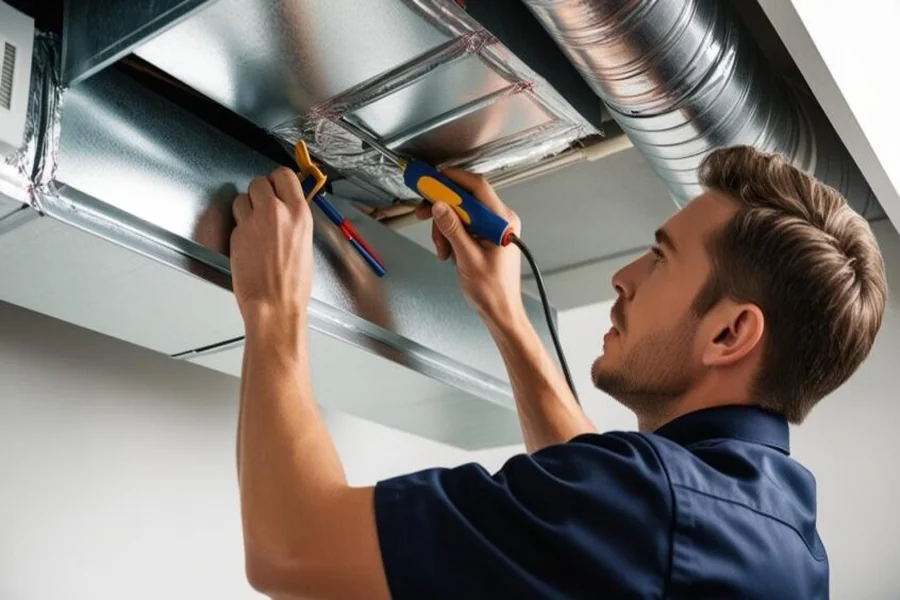
When a building is not cooling properly, most people blame the air conditioner first. That is a reasonable instinct, but it is often incomplete. Weak cooling, uneven temperatures, and long run times do not always mean the equipment itself is failing. In many cases, the air conditioner is operating while the duct system is undermining how that cooling reaches the space.
Why The Wrong Diagnosis Costs More
-
Why The Distinction Matters Early
For property managers, facility managers, and building owners, the difference between an equipment problem and a ductwork problem matters because it changes the entire repair path. Replacing parts inside the condensing unit or air handler will not solve poor cooling if conditioned air is being lost, restricted, or misdirected after it leaves the equipment. In markets such as Port Chester, where summer demand can expose both aging systems and distribution weaknesses, that distinction becomes even more important. A careful repair service does not start by assuming the outdoor unit is the problem. It starts by identifying where performance is breaking down.
-
How The Service Call Usually Begins
A good diagnostic process starts with the pattern of complaints. Is the entire building warm, or only certain rooms? Does the system cool better at night than during the afternoon? Are some vents weak while others seem normal? These questions help narrow whether the issue is likely tied to cooling production or cooling delivery. If the equipment is failing, symptoms often appear across the whole system. If the ductwork is involved, the problem may be more uneven, with certain zones consistently underperforming while the equipment still appears to run normally.
-
What Equipment Problems Usually Look Like
When the problem is in the equipment, the signs often show up in measurable operating conditions. The system may struggle to lower the indoor temperature at all, produce insufficient temperature drop across the coil, short-cycle, freeze up, or run with abnormal refrigerant pressures. A technician will typically check refrigerant charge, evaporator coil condition, condenser performance, electrical readings, blower operation, and thermostat communication. These checks help determine whether the AC system is actually producing the cooling it should. If those values are off, the issue is more likely to be within the equipment than in the duct network.
-
What Ductwork Problems Tend To Show
Ductwork issues create a different pattern. The equipment may be generating cooling correctly, but the building still feels uncomfortable because air is not reaching occupied spaces as intended. This often shows up as hot and cold spots, weak airflow from selected vents, temperature differences between rooms, or long run times that do not improve comfort evenly. Leaky ducts, disconnected runs, crushed flex ducts, closed dampers, poor insulation, or undersized sections can all reduce delivered cooling. In those cases, the air conditioner may not be the source of the problem at all.
-
Airflow Testing Helps Separate The Two
One of the clearest ways a repair service distinguishes equipment trouble from duct trouble is through airflow testing. If the blower is operating and the system is cooling properly at the air handler, but airflow at the supply registers is weak or inconsistent, that strongly points to a distribution issue. Technicians may compare airflow between rooms, inspect return air performance, and evaluate whether certain branches are being starved. If airflow is low throughout the system, the problem may still involve the equipment, particularly the blower or filter conditions. If it is low only in select areas, the duct system becomes a more likely suspect.
-
Temperature Readings Tell A Bigger Story
Temperature measurements are another important part of the diagnosis. A technician may measure the air temperature entering the system, leaving the evaporator section, and reaching the supply vents. If the equipment produces a proper cooling drop but the air arrives much warmer at distant registers, that suggests heat gain or duct leakage. If the temperature drop is weak right at the equipment, the issue is more likely to be within the cooling system itself. This step matters because it prevents guesswork. It shows whether cooling is lost before it enters the ducts or after.
What A Proper Diagnosis Should Deliver
An air conditioning repair service determines whether the problem is in the equipment or the ductwork by combining symptom patterns with measurements, airflow evaluation, temperature readings, static pressure readings, and a physical inspection. That process matters because weak cooling is not a diagnosis by itself. It is only a symptom. For property owners and managers, the real value lies in knowing whether the system is failing to create cooling or to deliver it. Once that distinction is clear, the next step becomes more targeted, more cost-effective, and far more likely to solve the comfort problem without wasting time on the wrong part of the system.