
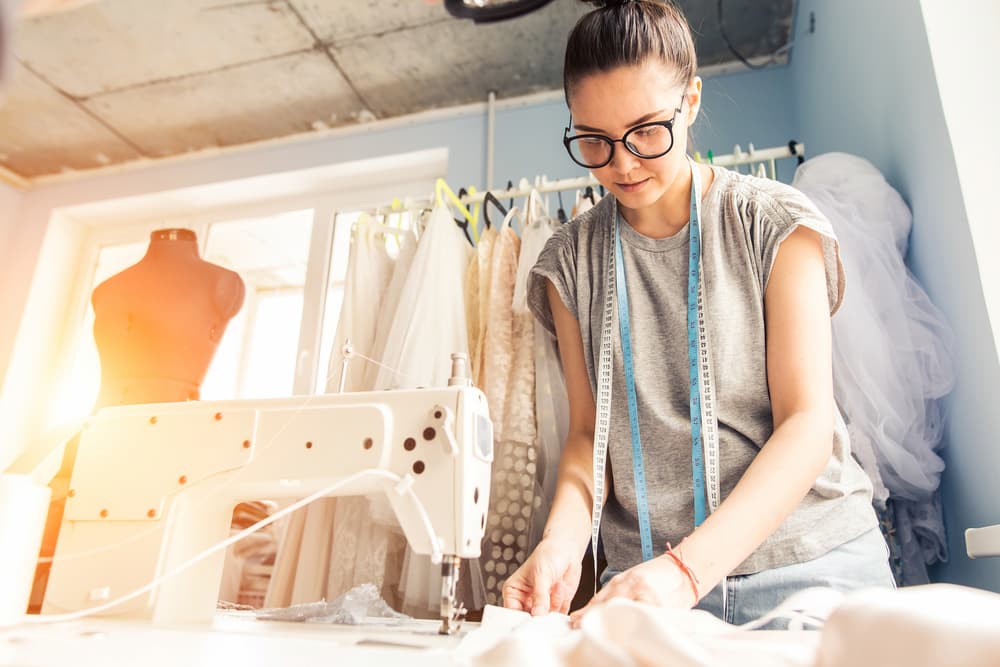
Personal style spent most of the last twenty years being a function of what was on the rack at any given retailer in any given season. The cultural model said that the consumer chose between options that someone else had already designed, sized and produced, and the most that personal style could mean was a particular combination of those pre-decided options assembled with care. That model has not disappeared, but a parallel one has been rebuilding itself for several years now, and the people inside it are quietly producing the most interesting personal style of the moment by sidestepping the retail layer entirely.
The instrument behind the shift, surprisingly to anyone who stopped paying attention to it, is the sewing machine. Not as a hobby in the dated sense of the word, but as a studio tool used by a generation of designers, illustrators, art directors, stylists, set decorators and creative professionals who have decided that the clothes they want to wear are the ones they will make. The machine is no longer a kitchen-counter object inherited from a grandmother. It is a piece of working equipment placed deliberately in a studio or workspace alongside the rest of the tools that produce creative output.
The aesthetic case for sewing is the part that gets undersold. A garment made for a specific body, in a specific fabric, with a specific cut, ends up looking different from a comparable garment off the rack regardless of the maker’s skill level. Fit alone does most of the work. A simple linen dress hand-cut to the wearers actual proportions reads on the body in a way that the same dress at the same retail price never quite achieves, because retail patterns are calibrated for an averaged body that does not exist. Personal style, properly understood, is partly the result of clothes that fit. Sewing is the only reliable route to clothes that do.
The material side of the picture is also worth taking seriously. Working with fabric directly produces an education in textile that no amount of retail browsing can replicate. The hand of a properly woven Irish linen versus a cheap blended substitute. The drape of silk crepe versus polyester crepe. The structural character of a heavyweight wool gabardine versus a lighter suiting cloth. Anyone who has spent six months sewing develops textile literacy that quietly transforms how they evaluate ready-to-wear, and the literacy tends to make the wearer more selective rather than more permissive about what eventually enters the wardrobe.
The equipment underneath this creative practice is mostly vintage. A working mid-century Singer or Bernina handles fabric in a way that modern budget machinery does not, and the difference shows up first in heavy materials like denim, canvas and leather where lighter modern machines simply cannot manage the load. Suppliers carrying parts and accessories for Vintage & Modern Sewing Machines have made the maintenance and operation of these machines straightforward, which is part of why creatives who treat sewing seriously almost always migrate toward older, heavier, more capable machinery rather than newer, lighter, more featured equivalents. The machine that lasted seventy years is the machine that will continue to last.
The slow-living dimension of the practice is not the marketing version of slow living. It is the practical reality that constructing a single garment takes hours, and those hours produce an output that retail cannot replicate. The time investment is part of what produces the meaning. The garment that took eight hours to make is worn differently from the garment that was bought in eight minutes, and the cumulative effect on the wardrobe is that fewer pieces are owned, each piece is worn more, and the relationship between the wearer and the wardrobe becomes deliberate rather than transactional.
There is also a creative-confidence effect that is harder to describe but consistently reported by people who have moved sewing into regular practice. Making something tangible with the hands has a way of unlocking creative confidence that translates into other parts of a creative life. Designers who sew tend to design more confidently. Illustrators who sew tend to illustrate more confidently. The creative practice cross-pollinates in directions that purely digital work does not produce, and the sewing studio ends up being a generative space rather than just a productive one.
The cultural shift is not that sewing has come back. It is that sewing has been recoded from a domestic skill into a creative discipline, taken up by people who did not inherit it and chose it deliberately, and run through machinery that was never supposed to outlast its original generation but has anyway. For anyone watching where personal style is actually being made now, the answer is increasingly inside studios and home workspaces that have a vintage machine on the bench and fabric stacked on the shelf.
FAQ
Do creative professionals really sew their own clothes? A growing share of designers, illustrators and creative-industry professionals do, often as a parallel practice alongside their main work.
What kind of machine is best suited to creative work? Vintage all-metal machines tend to handle a wider range of fabrics and weights than modern budget equivalents, which makes them well-suited to creative use.
How long does it take to learn to make wearable clothes? Most learners produce wearable garments inside their first three to six months of regular practice, with steady improvement from there.
Is sewing more expensive than buying clothes? Material cost can match or exceed mid-range retail, but the resulting garments fit better and tend to be worn for longer, producing a better cost-per-wear over time.