
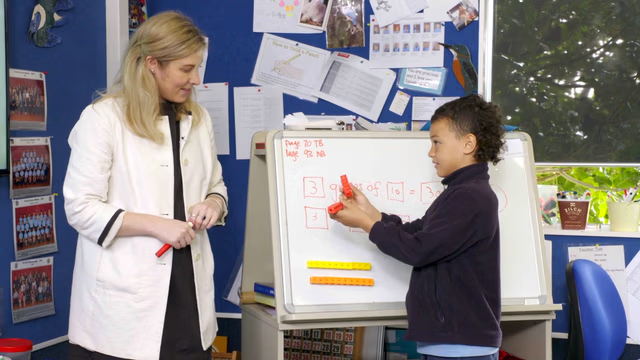
Maths teaching in New Zealand primary schools has come a long way from chalkboards and rote memorisation. Today’s classrooms rely on a mix of hands on materials, visual aids, and structured programmes to help children build genuine number sense rather than simply memorising facts. With the recent changes to the national curriculum placing even greater emphasis on strong foundational knowledge, choosing the right teaching resources and educational supplies has never mattered more. At Every Educaid, we work closely with teachers, schools, and parents to understand what actually works in the classroom, and this article rounds up some of the best maths resources available for New Zealand primary schools today.
Why the Right Resources Matter
Young learners think concretely before they think abstractly. A child who struggles to understand what “tens and ones” means on paper will often grasp it instantly once they can physically move blocks or beads into groups of ten. This is the entire premise behind manipulative based maths teaching, and it is why so many New Zealand schools have shifted their budgets toward practical, reusable classroom tools rather than relying solely on worksheets and textbooks.
Good resources do more than fill a shelf. They give teachers flexibility to adapt lessons for different ability levels, they keep children engaged through hands on learning, and they create opportunities for small group or one on one support where it is needed most. Investing in quality teaching resources and educational supplies pays off over years of use, since well made classroom tools can be passed down from one cohort to the next without losing their value.
Top Categories of Maths Resources for Primary Classrooms
Rather than listing individual products, it helps to think in terms of categories, since a balanced classroom usually draws from several types of resources at once.
- Place value tools: Hundreds boards, base ten blocks, and place value charts help children visualise how our number system is structured and how digits relate to one another.
- Counting and sorting materials: Counters, beads, and sorting trays support early number recognition, one to one correspondence, and basic grouping skills.
- Number lines and measurement tools: Physical number lines, rulers, and measuring tapes bring sequencing and measurement concepts to life in a way that is easy for children to visualise.
- Fraction and shape resources: Fraction circles, tiles, and geometric shape sets help children move from whole numbers into more abstract mathematical ideas like parts of a whole.
- Games and puzzles: Maths dice, dominoes, and pattern blocks turn practice into play, which is especially valuable for reinforcing skills without the pressure of formal assessment.
Choosing Quality Over Quantity
It can be tempting for schools to buy in bulk when budgets allow, but experienced teachers will often say that a handful of well designed, durable resources outperform a cupboard full of flimsy, poorly thought out materials. When selecting teaching resources and educational supplies, look for products that are clearly labelled, colour coded where appropriate, and built to withstand daily handling by dozens of small hands over the course of a school year.
At Every Educaid, our approach has always been to prioritise resources that are genuinely classroom tested rather than simply attractive on a shelf. A hundreds board, for instance, should have clear, easy to read numbers and a sturdy design that holds up to repeated use across terms and years. The same goes for counters, sorting trays, and measurement tools, all of which need to survive the realities of a busy primary classroom.
Supporting Teachers Beyond the Materials
Resources alone are not enough. Teachers also benefit from guidance on how to use each tool effectively, whether that means suggested lesson ideas, differentiation tips for mixed ability classes, or simple activities that pair multiple resources together. A hundreds board paired with counters, for example, can support a wide range of activities from basic counting through to early multiplication concepts, depending on how a teacher chooses to use it.
Building a Well Rounded Maths Toolkit
There is no single resource that covers every aspect of primary maths teaching, which is why a thoughtful mix of tools tends to serve classrooms best. Schools that invest steadily in a range of teaching resources and educational supplies, rather than making one large purchase and stopping there, tend to see the most consistent results across year levels.
Every Educaid continues to support New Zealand schools and families by offering practical, well designed maths resources built for real classroom use. Whether you are setting up a new classroom, refreshing an existing maths corner, or simply looking to add a few reliable tools to your current collection, focusing on quality, durability, and genuine educational value will always serve your students better in the long run.