
For years, we have been hearing that homework is not beneficial for a student’s health. This article examines why homework should be banned based on the latest research. Dive deep to learn about the evidence and additional proof on this topic.
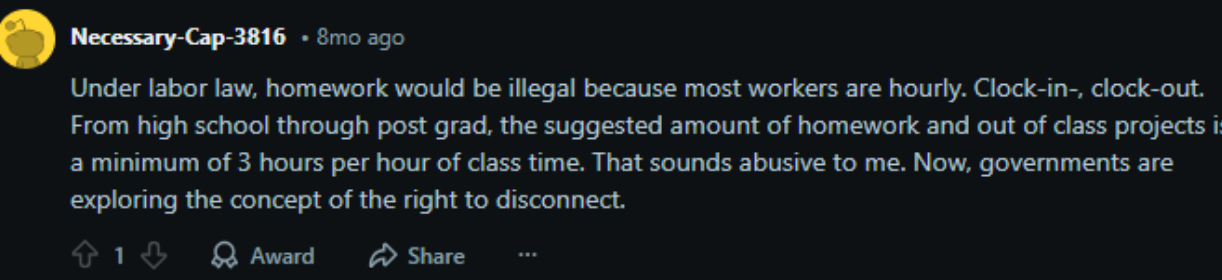
The conversation about banning homework in schools is not new. For many years, students have been complaining about it. In fact, on Reddit, users have even declared it illegal, citing it as unpaid labour.
However, the debate has now shifted from the student’s perspective to that of experts. Even many teachers and professors believe that the traditional model of evening study is outdated and does not fit the needs of modern children. This is where we must look at how academic pressure is affecting the mental health of the younger generation today.
That said, this article discusses the top 5 reasons why homework should be banned. To add depth and authority, we have collected scientific evidence. Continue reading to learn more.
Key Points You Can Expect in This Article
- The correlation between homework and grades is very low for primary school students in the UK.
- Excessive evening work leads to chronic sleep deprivation and physical ailments like headaches for most teenagers.
- Students are increasingly using generative artificial intelligence to finish their tasks, which reduces the actual learning value.
- Mental health issues like anxiety and depression are strongly linked to high academic pressure during the adolescent years.
- Families are experiencing more conflict and less quality time because of the constant demand for school assignments.
5 Top Reasons Why Homework Should Be Banned
The push for a homework ban is not new. In fact, many organisations and countries have taken steps to ensure that the homeworks don’t destroy the students’ mental health. They often fail to manage long hours of studies with personal time and rest. Some of them request assignment help online from top companies like The Academic Papers UK when workloads become too heavy to handle alone. The argument “why homework should be banned” is supported by a wealth of recent data that shows how the current system is failing our kids.
What this means is that the pressure to perform is often coming at a very high cost to their personal development. Let’s dive deep into the given sections to find the 5 reasons why homework should be banned:
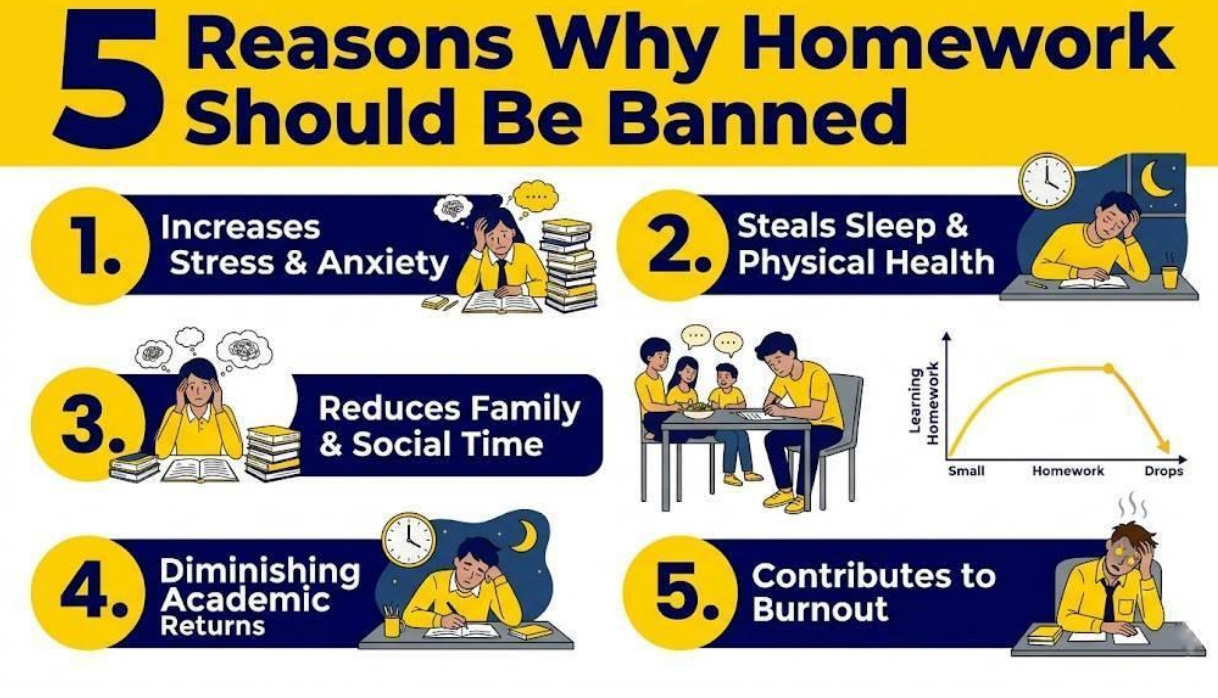
1. It Significantly Increases Stress and Anxiety
One of the most common answers to “why homework should be banned” is that it causes stress and anxiety. According to Save My Exams (14 February 2026), 58% of UK students find their homework to be at least moderately stressful during the academic year.
The emotional toll of constant schoolwork is one of the most pressing issues. Many students feel that they never truly leave the classroom because their assignments follow them through the front door of their homes. The following points highlight the reality check given by modern homework:
- According to UCL (2026), each one-point increase in academic pressure is associated with an eight per cent increase in self-harm risk.
- As per Guru At Home (14 November 2025), one in five UK children now has a probable mental disorder linked to academic environments.
Constant homework that follows you home can quickly build up stress and make it hard to switch off after a long school day. If you’re feeling overwhelmed by academic pressure, we have a complete assignment writing handbook to help you. Read it to learn more.
2. It Steals Time for Sleep and Physical Health
Regular homework and a lot of homework often disrupt students’ sleep schedules. Many kids and teenagers stay late at night past the recommended bedtimes just to satisfy the deadlines. This means they are compromising their next day and hurting their functional capabilities.
Pro tip: Making sure your child gets at least 9 hours of sleep is much more beneficial than finishing an extra worksheet.
That said, the following table contains some important stats that tell the tale of how deteriorating the homework could be for the physical health of the students.
| Physical Health Indicator | UK Student Statistic in 2026 | Source Name |
| Students with troubled sleep | 87% of all pupils | PubMed Central |
| Chronic sleep loss | 24 per cent report it often | Save My Exams |
| Average school night sleep | Less than recommended 8 hours per night | CDC |
| Physical stress symptoms | 82 per cent report headaches | PubMed Central |
3. It Reduces Family and Social Time
When children come home from a long day (around 6-8 hours)at school. Now, they want to relax and enjoy some time with the family. However, homework robs students of this freedom. That is why many parents feel that school is encroaching on their private family lives.
Because of the constant pressure, many households have become secondary workplaces where the stress of the day never really ends. You will notice that students also miss out on hobbies like music or sports, which are vital for a well-rounded personality. What this means is that we are trading social development for a few extra minutes of academic practice.
4. Diminishing Academic Returns After a Certain Point
In “why homework should be banned” debate, many educators still believe that more work leads to better outcomes. However, more homework often causes low academic returns. You will find that there is a point where adding more tasks actually lowers the interest and motivation of the learner. Furthermore, the rise of technology has fundamentally changed how students interact with their assignments.
The facts also show that there are many other problems with assuming that volume equals success in the modern world. You need to remember that children are not machines and their ability to absorb information has a natural daily limit. In other words, assigning more work often leads to less learning because the brain becomes too tired to function.
5. Contributes to Burnout and Mental Health Issues
8 hours of nonstop study at school and then grinding after school hours cause burnout and health-related issues. The feeling of being completely drained is no longer just an adult problem. It has also overtaken children due to the overwhelming school experience.
According to UCL (2026), exams have led to 8% increase in the odds of self-harm. When these kids grow, they struggle to manage their professional work, where 39% of young adults took time off due to mental issues, citing Mental Health UK (2026).
You can see this in how students withdraw from their favourite activities or lose their curiosity about the world. This is where we must address the long-term impact of pushing young people too hard before they reach the workforce.
Counterarguments: Why Homework Should Not Be Banned?
However, not all of the homework concepts are evil. We can’t apply the one-rule-fits-for-all principle under the umbrella of “Why homework should be banned” and completely ban it. Proponents of homework cited many reasons in favour, and honestly, they are not wrong. Let’s have a look at a few of the arguments “why should homework not be banned”.
- It builds discipline and helps parents stay involved with what is happening in the classroom.
- Practising skills like math or languages requires repetition that may not always be possible during school hours.
- Independent work at home prepares students for the heavy workloads of university life.
That said, a complete picture of one side without considering the other is not accurate. There should be a moderation in homework assignments, as well as each subject’s work must be personalised for each kid.
How Experts Help You Manage Homework Stress
Many students feel pressure when homework builds up. It becomes hard to stay focused and calm. Expert academic support through trusted assignment writing services can make this load easier to handle. It works by guiding students step by step so tasks feel clear and manageable. Complex topics become easier to understand, and deadlines feel less challenging.
Top ways experts reduce homework stress:
- Break large assignments into easy steps so work feels easier to start and finish
- Help you structure answers properly so your work stays organised and focused
- Improve time planning so you avoid last minute pressure and rushed submissions
- Support better focus so you spend less time feeling stuck and more time actually learning
- Build confidence by making academic tasks feel more manageable and less stressful
Conclusion
After reading this article, you have the answer to “why homework should be banned.” The evidence suggests that banning homework would lead to better mental health and more balanced lives for students in the UK.
You can expect that removing these burdens will allow children to rediscover their joy for learning and spend more time with their families. This means we must value well-being just as much as we value academic test scores.
Frequently Asked Questions About Why Homework Should Be Banned
Who invented school and why?
The invention of formal schooling was not the result of a single person. Some believe that the first formal educational institutions belonged to the Middle Kingdom era in Egypt between 2061 and 2010 BC. However, Horace Mann is often called the Father of Modern Education because he created the tax-supported school system in the 1800s.
Who invented homework and why essays?
An Italian teacher named Roberto Nevilis is often considered the founder of homework as a punishment in 1905. Although many people disagree, no one is actually known as the inventor of homework. We also have evidence of home from the Prussian education system.
What are the 10 disadvantages of homework?
The following are the 10 cons of homework, leading to the arguments for banning it completely:
- It causes high levels of stress and anxiety for the majority of students.
- It leads to chronic sleep deprivation, which harms the developing brain.
- It creates conflict in the home and ruins the parent-child relationship.
- It causes physical health problems like chronic headaches and stomach issues.
- It worsens the digital divide because some kids lack resources at home.
- It leads to early academic burnout and a loss of interest in school.
- It encourages cheating and the use of artificial intelligence to skip learning.
- It limits the time that children spend playing and being physically active.
- It offers no measurable academic benefit for primary school children.
- It destroys the intrinsic curiosity and joy that students should find in learning.