
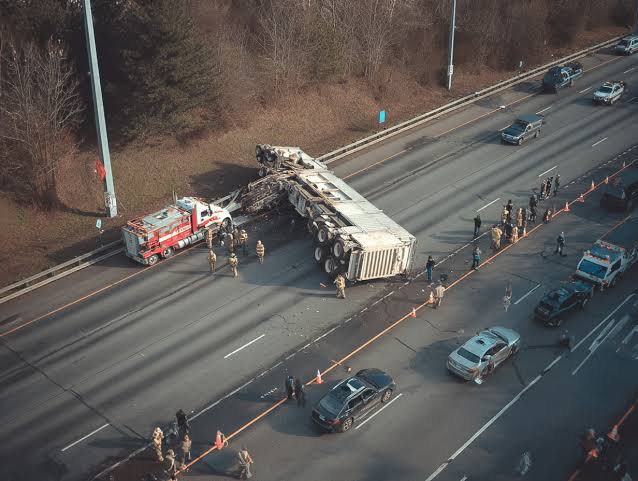
The first few hours after a commercial truck crash are often the most important for everyone involved. While injured drivers and passengers receive medical care, trucking companies may already be documenting the collision, reviewing vehicle data, and notifying insurers. Many attorneys who handle commercial vehicle cases note that the earliest stages of a Clinton truck accident case can significantly shape how the claim develops.
Clinton, Massachusetts sits in Worcester County, where Route 110, Route 62, and Route 70 converge near the town center and continue toward Lancaster, Berlin, Boylston, Sterling, and West Boylston. Commercial trucks moving between I-190, I-290, and nearby industrial corridors regularly pass through this stretch of road, and the mix of local traffic, the Wachusett Reservoir area, and truck routes can make crashes here especially complex to sort out.
Commercial trucking companies maintain driver records, inspection reports, electronic logging data, and maintenance histories that may become relevant during an investigation.
Calling 911 and seeking medical attention are essential first steps, but truck collisions often require extra attention because evidence is time-sensitive, multiple parties may share responsibility, and state and federal regulations may apply. The steps below explain why the first several hours after a truck accident often shape the legal process that follows.
1. Seek Medical Attention as Soon as Possible
Personal safety comes first. Anyone involved in a truck accident should move to a safe location if possible and accept medical evaluation from emergency responders.
Some injuries appear immediately, while others, such as concussions, whiplash, and internal injuries, develop gradually and may not produce symptoms for hours or days. Early evaluation supports treatment and creates documentation that can later help explain when an injury occurred. Medical records often become one of the most important pieces of evidence in a personal injury claim.
2. Contact Law Enforcement
A police report provides an official record of the collision, typically documenting vehicle positions, roadway conditions, damage, weather, and driver statements. For commercial truck accidents, this report frequently becomes one of the first documents reviewed during an insurance investigation.
Drivers involved in crashes within Clinton can generally obtain a copy of the completed report through the Clinton Police Department once it has been processed. Cases that move forward legally are typically handled through Clinton District Court at 300 Boylston Street, which covers Berlin, Bolton, Boylston, Clinton, Harvard, Lancaster, Sterling, and West Boylston.
3. Preserve Evidence at the Scene
If it is safe to do so, photographs taken immediately after the collision can preserve details that may later disappear, including vehicle damage, skid marks, roadway conditions, traffic signals, cargo, and surrounding intersections. Witness contact information can also provide valuable context later. Physical evidence often changes quickly once emergency responders clear the roadway.
4. Understand Requests From Insurance Companies
Insurance representatives may contact those involved to gather information about the accident. These conversations are routine, but statements made during them can become part of the claim file. Many attorneys recommend understanding the purpose of a recorded statement before giving one, particularly to another party’s insurer, and sticking to accurate information rather than speculation.
5. Preserve Commercial Truck Records
Commercial vehicles generate far more operational information than passenger cars, including Electronic Logging Device records, Event Data Recorder data, maintenance histories, inspection reports, dispatch communications, and GPS data. Some of these records are federally mandated, while others are retained only for limited periods depending on company policy, so attorneys handling truck cases often send preservation requests early to help ensure evidence remains available.
6. Document Every Financial Loss
Medical expenses are only one part of the financial impact of a serious truck accident. Many people also face lost wages, transportation costs, prescription costs, rehabilitation expenses, and property damage. Keeping organized records from the start makes it easier to document the full economic impact as the claim progresses.
7. Begin the Investigation Early
Commercial truck accidents frequently involve more than one responsible party. Investigators may examine the truck driver, the motor carrier, maintenance providers, cargo loading companies, or vehicle manufacturers, reviewing maintenance records, inspection reports, employment records, and federal compliance documentation.
Because several businesses may hold relevant evidence, beginning the investigation promptly helps preserve information before routine retention practices affect its availability.
Why Multiple Parties May Share Responsibility
Commercial trucking collisions rarely involve only two drivers. A driver may have been distracted or fatigued. A carrier may have failed to maintain equipment or supervise drivers properly. Cargo may have shifted because it was improperly loaded, or a defective tire, brake, or steering component may have contributed to the crash. Maintenance contractors and manufacturers may also become part of the investigation, so evaluating each possibility requires careful review rather than assumptions made right after the crash.
Federal and State Regulations Matter
Commercial trucking companies operate under Federal Motor Carrier Safety Administration (FMCSA) regulations covering driver qualifications, hours of service, inspections, maintenance, electronic logging, and cargo securement. Violations identified during an investigation may become relevant to a negligence claim.
Massachusetts also sets legal deadlines for personal injury claims, generally a three-year statute of limitations for motor vehicle cases. But evidence does not last indefinitely: electronic records get overwritten, footage gets deleted, and memories fade. Preserving evidence early is often just as important as tracking the filing deadline.
Why Early Investigation Can Matter
Truck accident claims differ from ordinary car collisions because they involve larger vehicles, more documentation, multiple insurance policies, federal regulations, and several potentially responsible parties. The first several hours often determine how much evidence remains for investigators to review, and medical records, police reports, photographs, witness information, and trucking records together form the foundation for evaluating liability and damages.
These early steps help explain why truck accident investigations in Clinton, Massachusetts and the surrounding Worcester County towns tend to be more detailed than standard car accident claims, and why preserving evidence from the start matters so much under Massachusetts law.
Frequently Asked Questions
Where do I get a copy of the police report for a truck accident in Clinton, MA?
Through the Clinton Police Department once it has been processed.
Which court handles truck accident cases from Clinton?
Clinton District Court, at 300 Boylston Street, Clinton, MA 01510, serving Clinton, Berlin, Bolton, Boylston, Harvard, Lancaster, Sterling, and West Boylston.
How long do I have to file a truck accident claim in Massachusetts?
Most claims carry a three-year statute of limitations, though the deadline can vary by case.
Why do truck accidents near Clinton often involve more than one at-fault party?
Because carriers, maintenance providers, and cargo loaders operate alongside the driver under federal and state regulations, more than one business may share responsibility.