
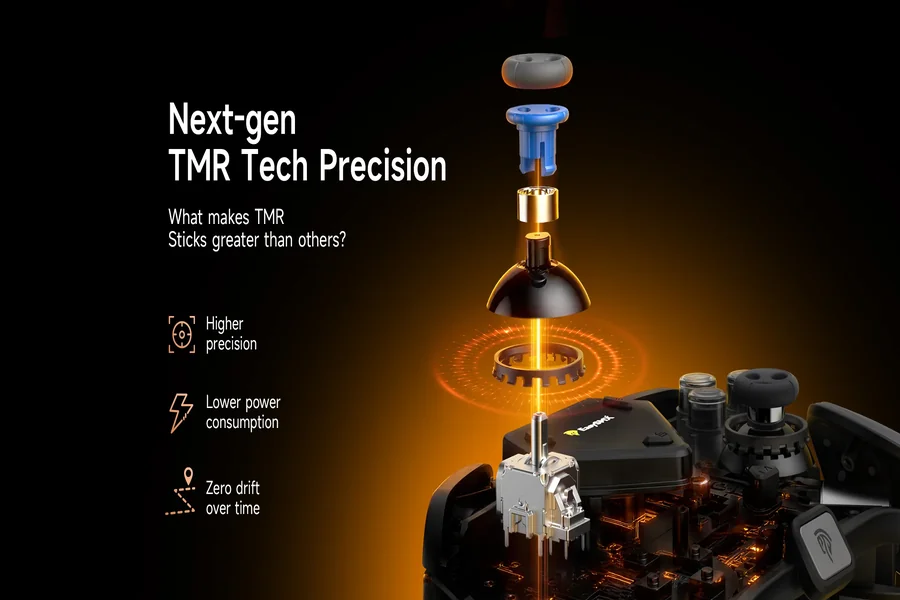
For decades, controller stick drift was an inevitable nightmare for gamers. Whether navigating an intense match in a competitive shooter or making precise turns in a racing sim, few things were as frustrating as watching your in-game camera or character slowly drift across the screen without input.
Historically, controller manufacturers relied on cheap potentiometer-based joysticks. Potentiometers use physical wiper arms that slide against a resistive graphite track to measure movement. Over time, friction causes these physical contacts to wear down, depositing debris and causing erratic voltage signals—the root cause of stick drift.
Today, thanks to major leaps in magnetic sensing technology, stick drift is finally becoming a relic of the past.
The First Revolution: Hall Effect Sensors
The modern battle against stick drift began with the wide adoption of Hall Effect sensors. Instead of physical contact points sliding against each other, Hall Effect joysticks use a contact-free magnetic design.
Inside a Hall Effect stick, a tiny magnet moves relative to a stationary sensor. As the joystick tilts, the sensor detects subtle changes in the magnetic field strength and translates them into precise digital positional coordinates.
Key Benefits of Hall Effect:
- Zero Physical Friction: Without wiper arms scraping against a track, mechanical wear and tear are virtually eliminated.
- Long Lifespan: Hall Effect modules are rated for tens of millions of cycles, drastically outlasting traditional potentiometers.
- Precision Deadzones: Players can set near-zero deadzones in game settings, delivering hyper-responsive aiming without fear of random drifting.
The Next Generation: TMR (Tunnel Magnetoresistance) Sensors
While Hall Effect technology set a new baseline for reliability, hardware engineers pushed the boundaries further with Tunnel Magnetoresistance (TMR) sensors.
TMR technology represents the next evolution in magnetic sensing. Originally developed for advanced hard drive read heads and automotive engineering, TMR utilizes quantum mechanical tunneling to measure magnetic direction with extreme accuracy.
Hall Effect vs. TMR Sensors
| Feature | Potentiometer | Hall Effect | TMR Sensors |
| Mechanism | Physical friction wiper | Magnetic field strength | Quantum magnetic tunneling |
| Stick Drift Risk | High (inevitable wear) | Near Zero | Zero |
| Power Consumption | Low | Moderate | Ultra-Low (battery friendly) |
| Precision & Sensitivity | Standard | High | Ultra-High |